
By the NLCA Project Team
We examined patterns of genomic testing and the use of targeted therapies among people diagnosed with lung cancer in England in 2022. The analysis used data from the National Disease Registration Service (NDRS), including genomic testing records derived from submissions to NDRS, linked to cancer registration data and the Systemic Anti-Cancer Therapy (SACT) database. The primary aim was to assess the completeness of genomic testing data within NDRS.
The analysis focused on people diagnosed with advanced-stage NSCLC (stage 3B-4) and who had good performance status (PS 0-1) at diagnosis.
Across cancer alliances, there were 6,379 patients with advanced-stage NSCLC and good performance status. Of these, 2,694 patients (42.2%) had a recorded result for EGFR (n=2,559, 39.9%) or ALK (n=1,974, 30.7%) testing, while 3,685 (57.8%) had no test recorded. Given the high proportion of missing data, these figures should be interpreted as minimum estimates of testing, rather than true testing rates.
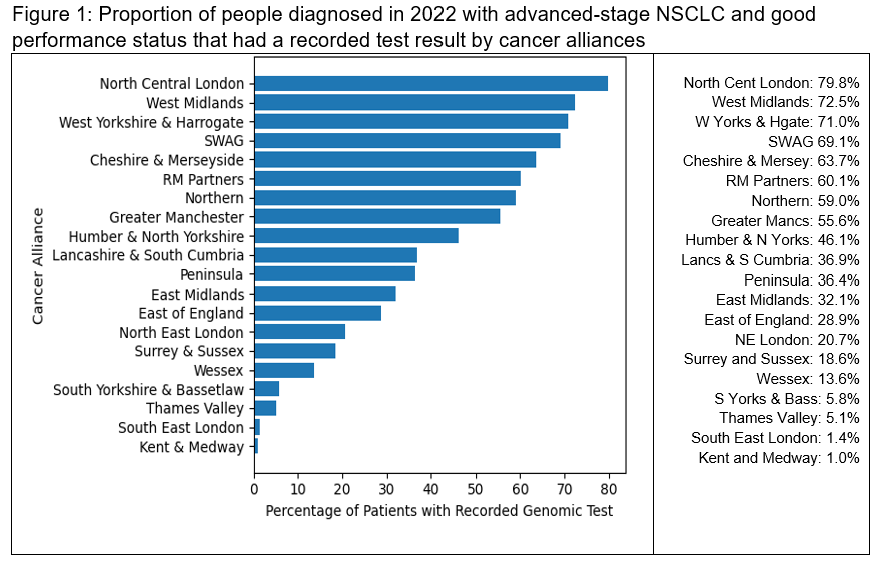
The proportion of people with a recorded test result varied substantially between cancer alliances, with the proportion ranging from under 5% to over 75% (Figure 1). This degree of variation is unlikely to reflect true differences in clinical practice and instead strongly suggests inconsistent or incomplete capture of genomic testing data across regions.
Correspondence between genomic testing records and receipt of targeted therapy
The genomic testing records were compared with data on targeted therapies in the SACT database among the patients with stage 4 NSCLC diagnosed in 2022 and good performance status.
There were 800 patients identified in SACT who received targeted therapy. Across cancer alliances, targeted therapy treatment rates (stage IV NSCLC, PS 0–1) were broadly consistent, with most ranging between 8–16%. Among the 800 patients who received targeted therapy, only 58% had a recorded genomic test result. As targeted therapies are prescribed based on the presence of an actionable mutation, this finding provides strong evidence of incomplete capture of genomic testing data within the linked dataset.
Use of targeted therapy among NSCLC patients with recorded mutations
In 2022, among patients with advanced disease:
- 324 stage IV patients with PS 0-1 had a positive EGFR or ALK test
- 261 (81%) received targeted therapy
These findings are broadly consistent with expected clinical practice, suggesting that treatment data capture is more complete than genomic testing data.
Key Concern: Incomplete Genomic Test Capture
- Only 42% of patients nationally have a recorded genomic test result
- Substantial regional variation in recorded testing rates
- Only 58% of patients who had targeted therapy had a recorded genomic test
these findings strongly suggest that the genomic testing dataset substantially underestimates the true level of molecular testing in clinical practice.
Implications
- Current data cannot be used to reliably benchmark genomic testing rates across regions
- Assessment of appropriate use of targeted therapies using linked datasets is limited
- Incomplete data masks true variation and inequalities in access to molecular testing and systemic anti-cancer therapy
Addressing these data gaps is essential to ensure that national datasets can support accurate audit, service evaluation, and policy decisions in lung cancer care.