
Here we showcase examples of best practice from NHS trusts that have successfully used audit insights to drive measurable improvements in their data quality.
These real‑world examples highlight practical approaches, lessons learned, and replicable methods which other trusts can use as a reference when considering their own quality improvement approaches.
By sharing these stories, we aim to support trusts in adopting effective, evidence‑based improvements that strengthen the quality of National audit data.

Improving staging data quality through MDT proformas and structured patient tracking
High-quality, complete data is essential for supporting clinical decision-making, enabling effective discussion in MDT meeting, and ensuring accurate national audit submissions. Improving data completeness also helps strengthen oversight of patient pathways, supporting timely diagnosis and treatment and ultimately contributing to better patient outcomes.
Over a one-year period, Barts Health NHS Trust increased the completeness of its Ann Arbor staging data from approximately 30% to over 70%, demonstrating significant progress.
Barts Health NHS Trust has implemented a series of practical changes within its haematology multidisciplinary team (MDT) processes to improve the completeness of key data items such as staging and performance status. These improvements have also supported better tracking of patient pathways and performance against national cancer targets.
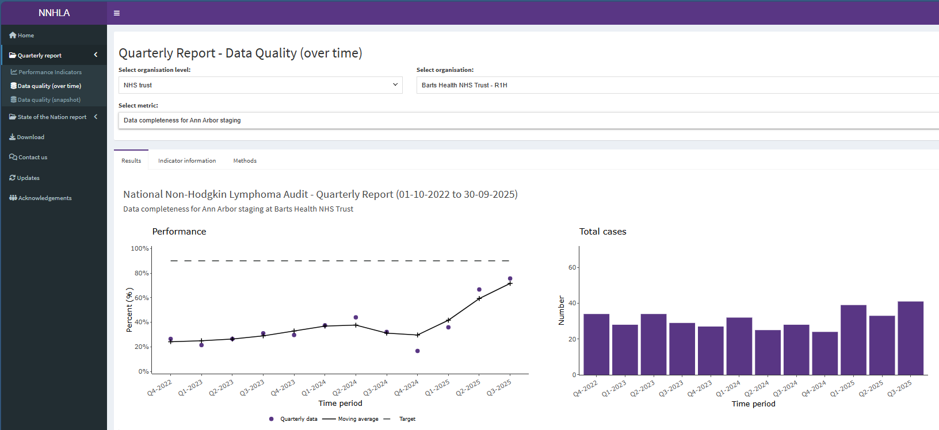
Data quality overtime- Ann Arbor staging for Barts Health NHS Trust between 1 October 2022 and 30 September 2025, extracted from NNHLA Quarterly Data Dashboard April 2026 release
Action Taken
1) Introduction of structured MDT (meeting) proformas by haematological disease groups and pathway
A suite of MDT proformas was developed to enhance data capture across different haematological conditions and contexts, including:
- Myeloid and leukaemia
- Myeloma
- Lymphoma
- Inpatient cases
- External referrals
Each proforma includes a designated section highlighting where updates are needed such as performance status, staging, and other key COSD Data items.
This approach has helped the trust to 1) understand patient volume in each group; 2) identify trends and gaps in meeting the 62 days target; 3) improve COSD data completeness.
2) Embedding data capture aligned with national data submission requirements
The proformas were designed to reflect the data fields required for data submission, helping to ensure that:
- Key information is recorded at the point of clinical discussion
- The data being recorded locally aligns with COSD and other relevant datasets requirement
- Completeness of required data items improves over time
This has supported more reliable and complete data submissions.
3) Weekly MDT review meetings for active patient tracking
A weekly structured review meeting was introduced between the MDT coordinator and MDT consultant. During this session:
- Each patient on the pathway tracking list (PTL) is reviewed
- Outstanding actions (e.g. diagnostics, results) are identified
- Decisions are made on whether patients can be removed from the PTL
This process has improved oversight of patient pathways; supported timely decision-making, and kept patients on the PTL to a minimum.
4) Regular pathway tracking list (PTL) escalation and communication process
Following the MDT review meeting, a PTL escalation process is carried out:
- Key issues (e.g. delayed diagnostics, dates requiring escalation) are identified
- A summary is shared with consultants, highlighting patients nearing pathway breaches
- Consultants provide input on patient management and PTL status
This ensures shared visibility across the clinical team and enables early intervention when any delays are identified.
Impact
The changes introduced at Barts Health NHS Trust have resulted in clear improvements in both data completeness and pathway oversight.
The impacts include:
- Ann Arbor staging completeness increasing from around 30% to over 70% within one year, reflecting a substantial improvement in data capture
- Better transparency of MDT activity across different haematological disease groups
- Enhanced ability to identify trends and areas for improvement
- Improved monitoring of performance against Faster Diagnosis Standard (FDS) and 62-day targets*
- More effective and efficient management of the PTL, helping to reduce backlog and avoid breaches.
The structured use of MDT (meeting) proformas has been particularly valuable in ensuring that key clinical information is consistently recorded at source.
Note: *People with high-grade lymphoma (Burkitt lymphoma (BL), DLBCL (Diffuse Large B-Cell Lymphoma) or high-grade T-cell) receiving SACT, who start SACT within 62 days of referral.
Who has been involved
This work has been delivered through a collaborative multidisciplinary approach, involving:
- MDT coordinators
- MDT clinical leads and consultants
- Cancer services and operational management
- Chemotherapy team representatives
- Wider MDT contributors supporting pathway monitoring and escalation
This collaborative working has been key to embedding the changes into routine practice.
Practical lessons other trusts may find helpful
Based on Barts Health NHS Trust’s experience, the following practical steps may support improvements in staging data completeness and pathway management:
- Introduce structured MDT (meeting) proformas tailored to disease groups and/or pathway to standardise data capture
- Align MDT documentation with COSD and other datasets requirements to support direct use in submissions
- Embed routine MDT review checkpoints to monitor patient progress and outstanding actions
- Establish regular PTL review and escalation processes to maintain oversight and minimise delays
- Promote shared visibility across clinical teams to support early action on patients nearing breaches
- Use MDT-level data to identify trends and inform service improvements.